
Shopping Cart
There are no more items in your cart
- 6203 views
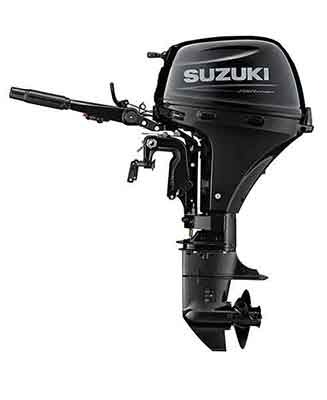
Outboard engines are engines located outside the stern of boats, on the exterior part of the transom. They consist of a propeller and a conventional engine that can be:
- 2-stroke
- 4-stroke
They differ depending on whether they take four or two strokes of the piston to complete a thermodynamic cycle. The 2-stroke engine is often recommended for smaller and simpler boats due to its lighter weight compared to the 4-stroke, immediate acceleration, easier transportation, and a more affordable price.
However, the 4-stroke engine has some advantages over the 2-stroke, such as lower pollution, more moderate fuel consumption, less disturbance in terms of noise and vibrations, a longer lifespan, and a broader power range.
Generally, outboard engines are found on boats ranging from 2 to 10 meters in length, including dinghies, inflatable boats, auxiliary boats, sailboats, and motorboats.
The choice between an outboard and an inboard engine in these boats is usually based on easier installation, simpler maintenance, and a more affordable price. Another advantage of outboard engines is their maneuverability and handling, allowing the motor to be pivoted and used as a rudder. It also allows for easy mounting and dismounting, facilitating transportation.
Today, there is also the possibility of having an electric outboard engine. If you want to learn more about it, click here.
Choosing an outboard engine
To make a good choice, various factors should be considered, such as:
- What type of boat do you have? The decision will be influenced by whether your boat is an inflatable dinghy, a rigid inflatable boat, a motorboat, a small cruiser, a fishing boat, or a sailboat.
- How is the boat being used? The decision may also be influenced by whether the boat is used for purposes such as fishing or sports.
- How much does it weigh and how much space does it occupy? This will primarily determine the type of engine needed for the boat.
As a general guide, you can use these generic references:
- 3.5 HP - 10 HP: For boats between 2 and 3.5 meters
- 15 HP - 50 HP: For boats between 3.5 and 4.5 meters
- 25 HP - 90 HP: For boats between 4.5 and 5.5 meters
- 40 HP - 115 HP: For boats between 5.5 and 6.5 meters
- 75 HP - 200 HP: For boats between 6.5 and 7.5 meters
- 90 HP - 250 HP: For boats between 7.5 and 8.5 meters
- 150 HP - 400 HP: For boats between 8.5 and 10 meters
There may be exceptions to these guidelines. For example, in the case of robust boats of 10 meters or more, two 400 HP engines can be installed, totaling 800 HP and reaching speeds of up to 40 knots.
In conclusion, decisions can be based on:
Outboard engine for small boats
For small boats such as inflatable dinghies, dinghies, rigid inflatables, small sailboats, a 2-stroke engine is a valid option, but we recommend a 4-stroke engine from 3.5 HP onwards. However, for optimal speed and performance, you should aim for a power range between 10 and 50 HP.
Outboard engine for sailboats
For sailboats, you should look for an engine with a longer shaft and greater propeller thrust to adapt to the stern of a sailboat. Regarding power, a motor offering at least 6 HP could fulfill its role as assistance when the wind is not favorable for sailing.
Outboard engine for auxiliary boat, rigid inflatable, or dinghy
For boats of this type, which already have a considerable weight and size, it is best to consider 4-stroke outboard engines with a medium to high power range.
Find your outboard engine at Mercanautic by clicking here. We have new, used, and second-hand outboard engines, as well as all kinds of accessories and spare parts to ensure you have everything for your boat.
Some of the most popular brands of 2-stroke outboard engines are
- Evinrude
- GO II
- Johnson
- Selva
- Tohatsu
- Yamaha
Some of the most popular brands of 4-stroke outboard engines are
- Honda
- Mercury
- Parsun
- Selva
- Suzuki
- Tohatsu
- Yamaha
If you need an outboard engine, click here.